
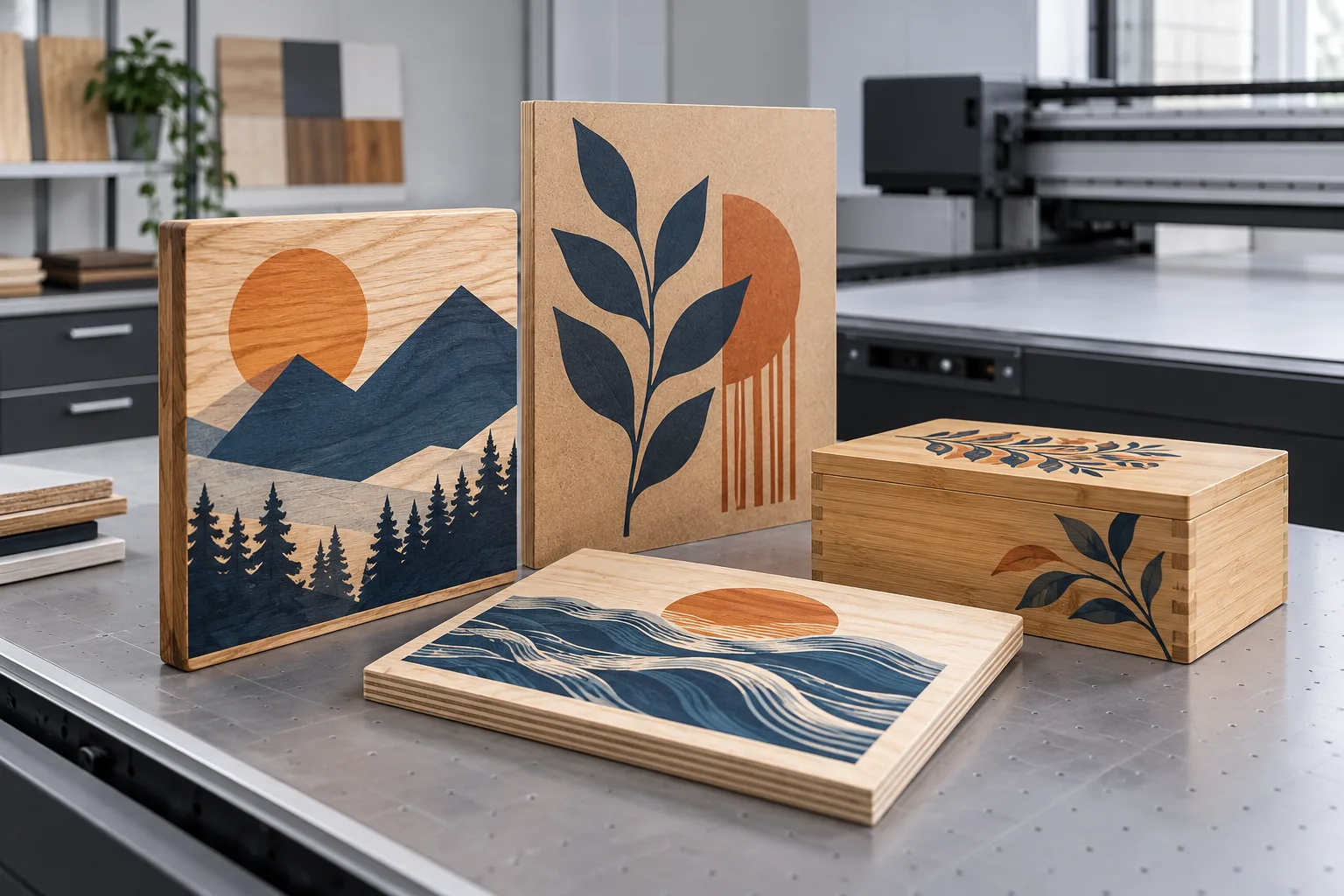
There is no single setup for every wood product. Identify the board and surface first, then compare cleaning, sanding or sealing on same-batch samples. Approve white ink, colour, adhesion and downstream fabrication before production.
Updated 23 September 2026 · Basis: SUNUSER material application notes · Scope: test method, not a universal adhesion guarantee
Separate the material families
Solid wood
Grain, pores, resin and moisture condition can change absorption and colour.
MDF and fibreboard
The face may be flat but absorbent; test raw, laminated and painted boards separately.
Plywood
Glue lines, veneers, fillers and surface finishes may create local colour or adhesion differences.
Bamboo and composite boards
Hardness, nodes, pressed layers and decorative faces require separate inspection.
Controlled sample workflow
Record supplier, construction, batch, thickness, both faces, surface finish and end use.
Check dust, wax, burrs, bowing, glue residue, protective film and existing paint or laminate.
Cut samples from the same batch, retain an untreated control and compare candidate cleaning, sanding or sealing methods.
Use the real artwork to test retained or hidden grain, white-ink order, colour and varnish requirements.
Run the agreed adhesion, rubbing, cleaning, cutting, drilling, bending or assembly checks.
Failure patterns to investigate
- Dark colour or edge spread
- Check uneven absorption, sealing consistency and whether the sample and production boards are the same batch.
- Local adhesion loss
- Inspect wax, resin, glue residue, laminate or old coating before blaming the ink alone.
- Bowing or head-strike risk
- Stop and review flatness, hold-down and raised defects. Do not hide significant bowing by simply increasing the gap.
- Failure after fabrication
- Include cutting, drilling, bending, cleaning and assembly in approval rather than accepting only the freshly printed flat board.
Wood UV printing FAQ
Can solid wood and MDF use the same process?
Do not assume so. Absorption, surface construction and existing coatings may be very different; keep separate samples and records.
Does wood always need white ink?
No. It depends on substrate colour, whether grain should remain visible, target colour and viewing effect. Decide from controlled samples.
Why are fixed sanding or moisture values not published?
Generic numbers in working notes do not represent every species, finish or environment. Follow the board supplier’s requirements and a technically reviewed process.